By an ordinary person. For ordinary people.
I’m not a financial advisor and I never studied finance. I taught myself stock analysis alongside a full-time job, with the books of Benjamin Graham and Peter Lynch and a book about Warren Buffett. Along the way I kept running into the same problem: most tools show you a result, but not how it comes about. That’s why I built Delta Metron.
- 2022Getting started, brokerage account
- Aug 2023First €50, first two ETFs
- 2023–2025Single stocks, ETFs – back and forth
- Apr 2025First book: “The Intelligent Investor”
- Oct 2025First prototype in a spreadsheet
- Jan 2026Work on the terminal begins
- TodayWaitlist open
Something was missing
For a long time I had the feeling that something was still missing in my life. I have a full-time job, and still do today. But I noticed that I expected something more from life. I wanted to build a second pillar – and I had a dream: to be an entrepreneur at least once in my life. Many people advise against it. But I believe the experience is worth something, even if you only go through it once.
I never believed in the quick money promised all over the internet. You can build something, I’m convinced of that. But anything worth doing demands perseverance and, above all, discipline.
A video about Warren Buffett
Then I came across a video about Warren Buffett, about his story and the way he thinks. It wouldn’t let go of me. In 2022 I started to take investing seriously and opened an account with a broker. Then I hesitated for months. Only in August 2023 did I deposit my first €50 and buy my first two ETFs – the classic route, just as everyone recommends.
Back and forth empties your pockets
After a few months, my first individual stocks came along. And then began a period in which, honestly, I didn’t know what I was doing. If a stock rose 5%, I sold it out of fear. If it fell 3%, I didn’t know what to do. Sometimes I panicked, sold all my stocks and bought ETFs, then sold the ETFs again and went back into individual stocks. I doubted myself and kept asking whether individual stocks were for me at all.
At some point I found a saying that has stayed with me ever since. In German it rhymes: „Hin und her macht Taschen leer“ – back and forth empties your pockets. Later I learned that Benjamin Graham warned against exactly this – more in the article Mr. Market.
The problem wasn’t the market. The problem was that I didn’t know what the stocks I owned were actually worth. And if you don’t know that, every move makes you nervous.
Learning from the best
So I wanted to learn it the way the best had done it. In April 2025 I bought my first book: “The Intelligent Investor” by Benjamin Graham, Warren Buffett’s teacher. After that came Peter Lynch’s three books and “The Warren Buffett Way” by Robert G. Hagstrom. They all had one thing in common: they thought differently from most people. They didn’t look at the share price, but at the company behind it – and asked what it is really worth.
Each was right, none alone
Something else became clear to me along the way. Each of these investors had his own method, and each has strengths and weaknesses. If you rely on just one, you only see part of the picture. So I decided: a stock gets valued in several ways, not just one.
And not every company can be valued the same way. A bank makes its money very differently from an industrial company, and a REIT, a real estate company, differently again. Each of these types needs the models that fit it.
The problem with the black box
I wanted to work out my fair value myself, not rely on whatever some tool shows me. That decision was one I didn’t want taken away from me. But most tools are exactly that: a black box. They show you a result, but not how it comes about.
And reading annual reports yourself, for thousands of companies, is simply impossible alongside a full-time job. Professionals have the whole day for it. People who work and invest on the side don’t.
From spreadsheet to terminal
So I started building it myself. In October 2025 the first prototype took shape in a spreadsheet: my first own DCF calculators in Excel. Only then did I notice that it really works. Once you have calculated fair value yourself, you are no longer alone with your decision. You get an answer to the questions that used to make you nervous.
I worked on the spreadsheet until December. In January 2026 I decided to turn it into a real application: a platform that shows a company’s numbers as clearly as possible and values every stock with the models that fit it. Since then I’ve been building Delta Metron – from the ground up and with real enthusiasm for the subject.
From the first spreadsheet until today, it has been well over 3,000 hours, alongside my full-time job: before work, after work, at weekends and on holiday too. On days off it was often 12 to 15 hours. Not because I had to – but because I wanted every number to be right.
Why it looks the way it does
Looking back, Delta Metron brings together things that were already with me at school. I was always interested in maths. I enjoyed giving presentations, because I like explaining things so that anyone can understand them. And I’m a bit of a perfectionist: even small details bother me until they’re right. That’s exactly why the terminal looks the way it does – and exactly why I make YouTube videos.
How Delta Metron makes money
Delta Metron earns its money exclusively through the subscription – nothing else. There is no paid advertising, no commissions from brokers or partners, no paid recommendations, and I don’t sell tips. So I don’t earn from what you buy or sell, only from the tool being good enough that you want to keep it.
That is why I deliberately build Delta Metron on my own as far as possible. It takes longer, but it keeps the tool independent.
What Delta Metron is for
Around me I keep seeing people buy stocks blindly because everyone happens to be talking about them. I know how that feels – I did it myself. Most of these mistakes can be avoided if you first ask what a company is really worth.
That is exactly what Delta Metron is meant to help with: a terminal by an ordinary person, for ordinary people, at an ordinary price. Every assumption visible, every number adjustable by you.
The journey goes on
I’m far from done – and I believe a tool like this is never quite finished. More features are coming, a dedicated phone app is planned, and here in Learn and on YouTube I keep explaining how to value companies yourself.
Whoever signs up now is there from the start.
My bookshelf
These books shaped the way I value stocks – in the photo in the order I read them. I read the German editions. Each of them lives on in a part of Delta Metron today.
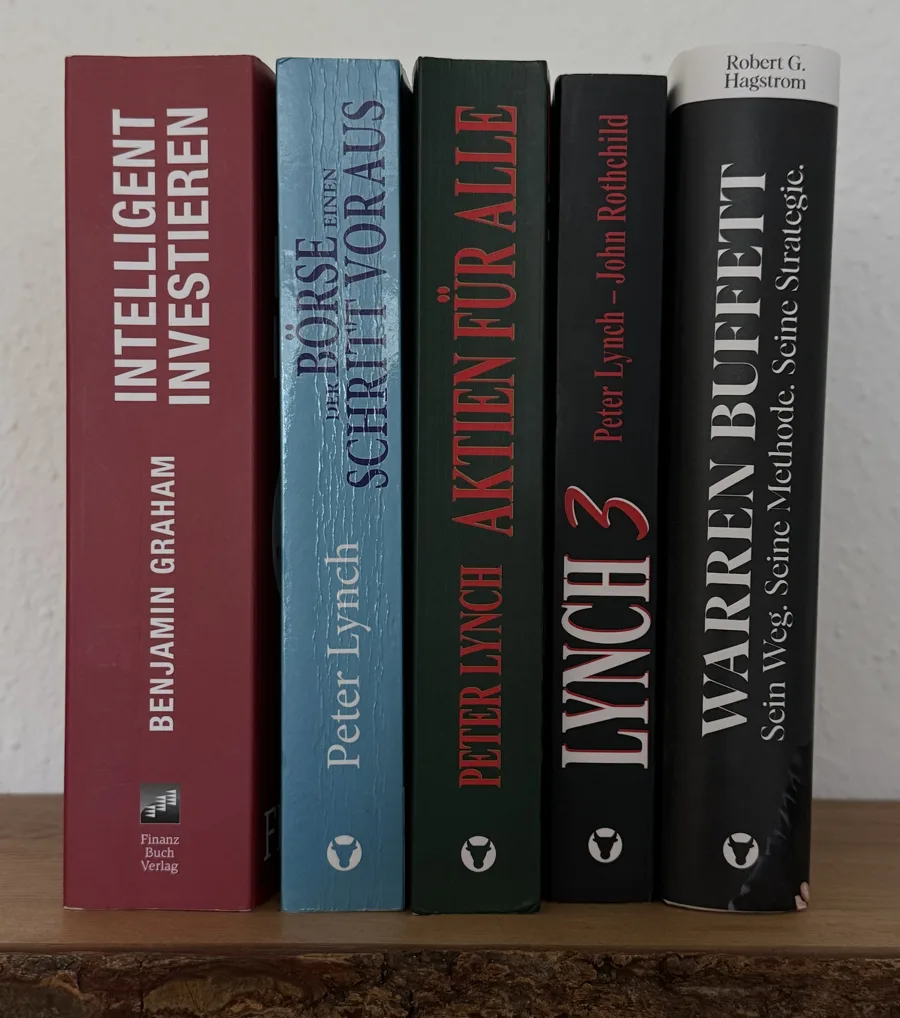
- Benjamin GrahamThe Intelligent InvestorThe margin of safety: never pay full price for an estimated value. And “Mr. Market”, who is too euphoric one day and too fearful the next – you don’t have to follow him.
- Peter LynchOne Up on Wall Street · Beating the Street · Learn to EarnInvest in what you understand. And sort stocks into types – not every company should be valued the same way. That idea lives on in the dedicated models for banks and REITs.
- Robert G. HagstromThe Warren Buffett WayBuy a business, not a stock. And look at what it really earns – Buffett calls it “owner earnings”.
More from me: on YouTube I explain how to work out fair value yourself.
YouTube channelValue stocks the way you understand them.
Delta Metron calculates three models per company type for more than 6,000 stocks – every assumption visible and adjustable by you. Sign up for free: The first 100 on the waitlist pay €5 instead of €10 a month at launch, for life.
I’m not a financial advisor. Delta Metron does not give buy or sell recommendations – it is a tool for people who want to understand their own decisions.